
Every site running a long overland has a way of finding bad rollers before they find you. On most sites that way is still a person, walking or driving the line and listening. This page is about that job: what it catches, what it can't, and the decision that follows.
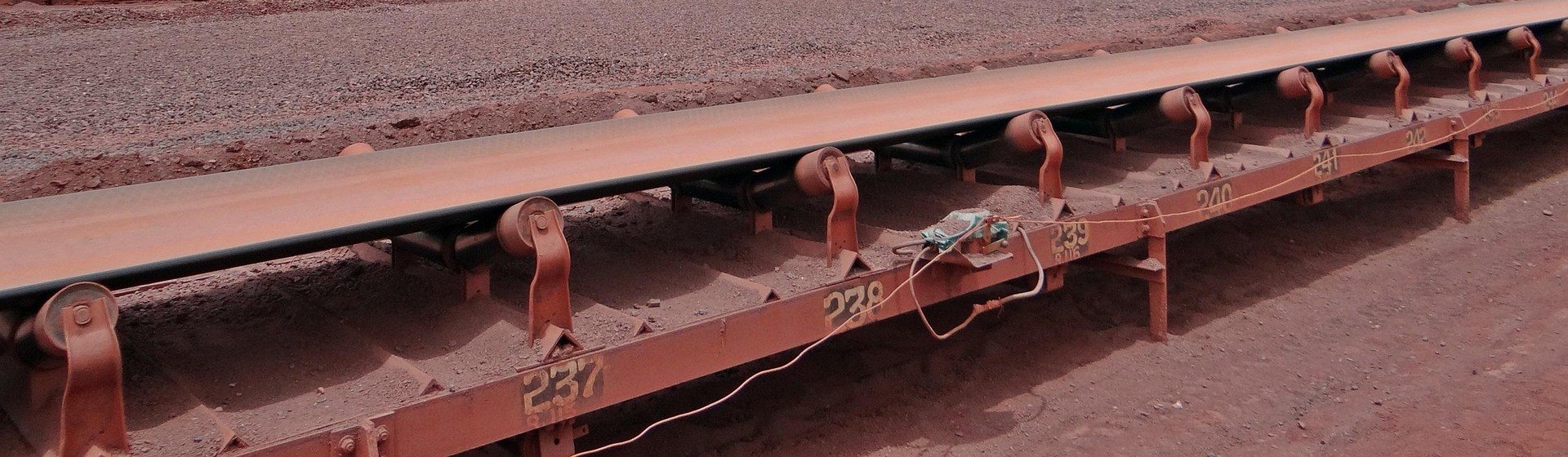
On most Australian sites, roller condition is judged by people on the ground. Production crews walk the belts they run, especially the ones carrying the tonnes. Belt crews and mechanical teams add scheduled inspections on top. How often a section gets a close look depends on the site, the belt and how far it is from a road. A plant-area conveyor may be seen every shift, while the middle of an overland can go a good deal longer between visits.
The walk is a stop, listen, move rhythm, station by station. The walker listens for rollers that don't sound like their neighbours: a growl, a rumble, a tick, a squeal, a roller running out of step. They look for wobble, shell wear, flats, build-up around the ends, and a seized roller with the belt dragging over it. They check for heat with a temperature gun or a thermal camera, and they notice smell. Anything suspect gets a tag on the frame and a line on the sheet, and later a work order.
Knows what each section is supposed to sound like, and where trouble usually starts: the wing rollers, the loading and impact zones, the high-tension end, the return run. Stops long enough at each station to pick one roller out of the set. Covers the far side where it can be reached. Goes back to what was tagged last time to hear whether it has changed.
Above all, can tell a roller that has growled for months from one that wasn't growling last week.
Hears the same noise with nothing to compare it to. That isn't a question of effort. The skill is learned on the job, crews turn over, and what a good walker knows lives in their ears and memory rather than in a record.
A walk is a snapshot.
A bearing that starts to go the day after a walk keeps going until the next one, with nobody there to hear it change.
A small defect on a race or rolling element shows up in the bearing well before it makes a noise that carries over a loaded belt, a drive and the wind. By the time a roller is audible from the walkway, the damage is already some way along. The walker isn't missing it: at that distance there is nothing yet to hear.
Plenty of noisy rollers keep turning for a long time. Some give little audible warning and are found by heat, smell or belt damage. On many sites noise is the main reason a roller gets tagged, so noise does the selecting rather than the condition of the bearing. "It's making noise" and "it needs to come out" are different statements, and the walk mostly produces the first.
In a noisy station, sound carries along the stringer and across the set, so three rollers side by side can sound like one. The tag goes on the frame, and the fitter works out the rest on the day.
A roller tagged as noisy stays on a list. Whether anyone knows it is getting worse depends on someone walking back to it and remembering what it sounded like before.
The post-mortem usually can't separate four explanations.
It was quiet on the day.
It was drowned out.
It sat on a section that only got a quick look.
It simply started after the walk.
All four look the same afterwards.
Every failure mode has a P-F interval. P is the first point at which a developing fault can be detected. F is the point at which the component has failed. What you can do about a fault depends on where on that curve you first find it.
For an idler bearing the evidence arrives in a rough order: friction changes and small impacts inside the bearing, carried as ultrasonic stress waves; then vibration in the frame; then noise that carries to the walkway; then heat; then smell, smoke or a seized roller.
A belt walk works in the second half of that curve. Ears, a temperature gun and a thermal camera are good at the late signs, and they are the only practical tools across thousands of positions. They are not built for the early signs. That is where human senses sit on the curve, not a failing of the walker. Most idler bearings are sealed for life, so oil analysis and in-service greasing aren't available either.
How long a bearing spends between signs depends on load, contamination, seal condition and how the damage started. Some faults move slowly down the curve and some drop off it. A noise tells you roughly where a roller is on the curve, not how much time it has left.
It can say where a roller was on the day. It can't say which way it is moving, or how fast.
When a fault is found, someone has to decide what to do with it: take the belt down and change it now, or leave it running, keep an eye on it and change it at a planned stop.
A belt comes down straight away when a roller is cutting it or presents a fire risk. Everything short of that is a judgement, made with workarounds in between: re-walk it every shift, wet it down, cool it, put it on a list and hope.
Is this roller worse than last week, or has it sounded like this for a month?
Is the noise from the tagged roller or the one beside it?
Is anything else in the section heading the same way?
Can someone who wasn't there hear it without walking out?
A belt comes down for a roller that had more in it. The tonnes are lost, and the next time maintenance asks for a stop, the answer comes slower. Whole zones get changed at the shut out of caution because nobody can say which rollers are fine.
A roller seizes. The shell wears through, the belt gets damaged, heat builds, and a planned changeout becomes an unplanned stop, with a bigger job done under more pressure than the one that was deferred.
Neither mistake is visible when the decision is made. Both are obvious afterwards.
If the people making these calls could design the situation, they would ask for something like this.
Not a replacement for the walk. Something watching during the days and nights the walk isn't there.
Overland sections, gantries, crossings, guarded runs and the far side, seen as often as the belts near the plant.
Before it's audible from the walkway. Enough notice to plan around rather than react to.
Stable, getting worse, or getting worse faster. The same measurement taken the same way every time, whoever is on shift.
A few frames to look at instead of a kilometre to walk, so the walk goes where it is needed.
A trend and a recording a reliability engineer in Perth, the next shift or the production superintendent can see and hear without being there.
Across the whole conveyor: which zones are fine, which to watch, which need a look now.
How often it raises a flag that turns out to be nothing, counted and shown, so flags are trusted or discounted on evidence.
No batteries across thousands of positions, and no extra crew to keep it running.
None of this takes the decision away from the site. The call belongs to the people who know the belt, the plan and the risk.
Senstrali Triage is built around the front of the curve. Each node sits on the stringer and takes four measurements that together span the curve from the first friction changes through to heat.
Earliest mechanical evidence of distress.
Confirms a defect big enough to move the frame.
What the fitter will hear when they get there.
Late on the curve; counted only alongside another signal.
A distressed bearing produces ultrasonic stress waves before the defect is large enough to move the frame.
Belt, drive, loading and wind put most of their energy at lower frequencies, so a small bearing signal stands out on a noisy belt.
Ultrasonic signal fades quickly through steel, so a node hears mainly the frames around it. A flag points to a zone, not a stretch of conveyor.
Ultrasonic can also move for reasons that go nowhere, such as a short-lived change in lubrication, load or water ingress. That is why it is never read alone.
The fitter's question is not "is it noisy" but "what do I look at first".
Each zone is designed to be compared with its own baseline and ranked Healthy, Watch or Alert, then by how fast it is changing. A zone climbing quickly ranks ahead of one that has been high and steady for a month.
Ultrasonic rising on its own reads as early on the curve. Vibration and the audio band following it reads as later. Temperature joining in reads as late. Evidence for the call, not a rule that makes it.
A zone is designed to keep a recording from when it was healthy and one from now, so the fitter can hear what changed before walking out.
The walk goes first to the zones that are moving, and confirms or clears them. A cleared zone goes back to Healthy with a note, so the next shift knows it was looked at.
Triage does not say how long a zone has. Where a zone sits on the curve is not the same as time remaining. That question belongs to Senstrali Forecast, which is in development.
Scope, duration and success measures agreed with your site before anything goes on a stringer. See the development evidence.